
Shelf Life Calculator
Expiry Date
In an era where efficiency, sustainability, and inclusive growth matter, the shelf life calculator has emerged as a powerful, practical tool for manufacturers, farmers, regulators, and social development planners. This long-form article provides an in-depth, SEO-focused exploration of the shelf life calculator—its history, objectives, scientific basis, implementation strategies, state-wise impacts, links to women empowerment schemes and rural development, success stories, challenges, comparisons with alternative approaches, and future prospects. The goal is to equip practitioners and policymakers with a comprehensive understanding of how this tool can support regional impact, policy frameworks, social welfare initiatives, and economic resilience.
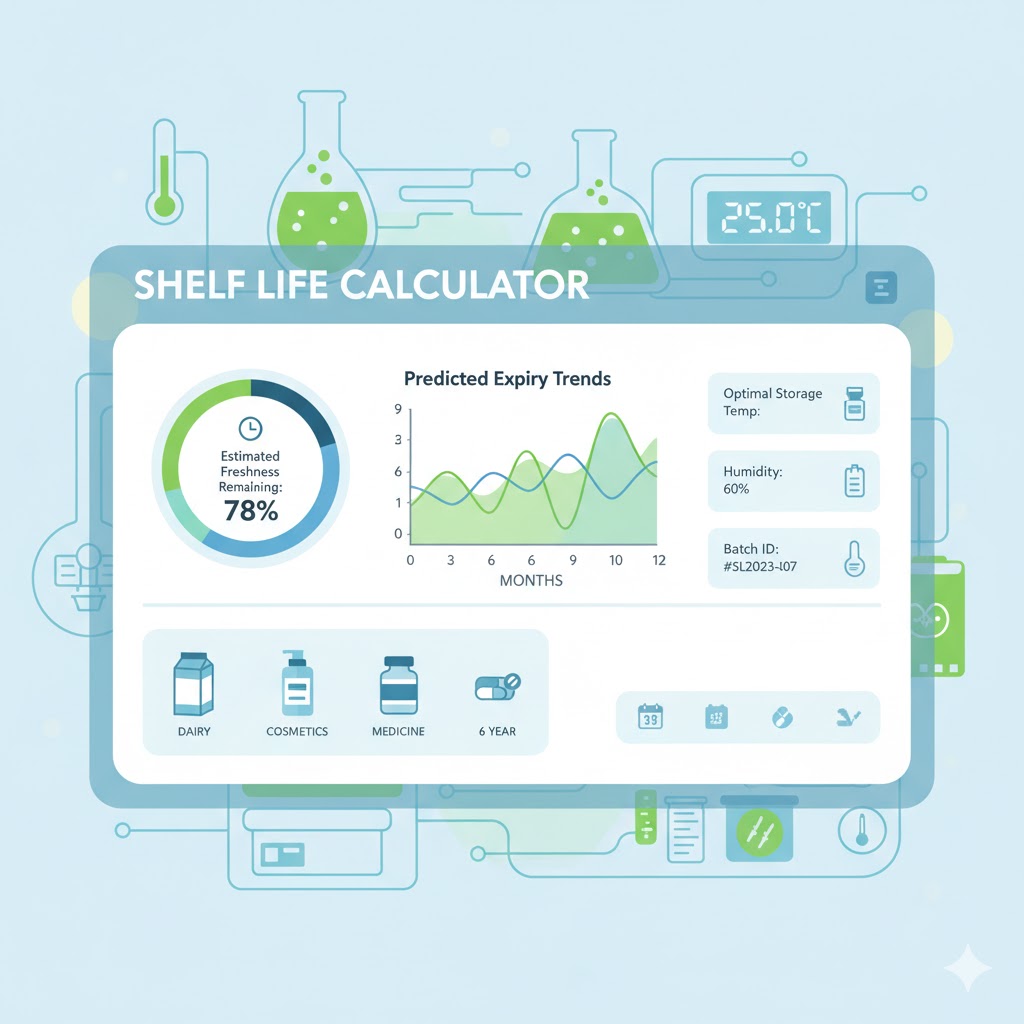
What is a shelf life calculator and why it matter
A shelf life calculator is a predictive instrument designed to estimate the usable life of perishable and semi-perishable products under specified storage and handling conditions. By combining product composition, processing parameters, packaging properties, and environmental variables, the shelf life calculator forecasts the time during which a product will remain safe, nutritious, and marketable. This prediction supports inventory decisions, labelling, procurement planning for welfare programs, and the design of supply chains that minimize waste.
The practical importance of an online shelf life calculator spans stakeholders: food processors can reduce spoilage and improve margins; small and medium enterprises, including women-led ventures, can plan better production runs; state agencies can design procurement and distribution schedules that maximize impact while minimizing losses; and rural development programs can use more accurate longevity estimates to protect incomes and support market access.
Historical context: from rule-of-thumb to data-driven forecasts
Shelf life estimation began informally—producers relied on experience, sensory checks, and conservative rules of thumb. As food systems industrialized, science-based methods developed. Microbiology introduced growth models, packaging science refined barrier technologies, and analytical chemistry provided metrics like water activity and oxidation measurements. Later, statistical reliability analysis and accelerated testing techniques made it possible to formalize these insights into predictive models.
The modern shelf life calculator evolved as these disciplines converged with computing power and data collection. Today’s tools combine empirical lab data, predictive microbiology, and statistical models to deliver probabilistic estimates rather than single-point guesses. This transition from anecdotal practice to validated prediction is central to reducing food waste and supporting policy frameworks that emphasize evidence-based planning.
Objectives of implementing a shelf life calculator
Implementing a shelf life calculator serves multiple objectives:
- Improve food safety by estimating when products may become hazardous.
- Decrease post-harvest loss and spoilage across supply chains.
- Optimize inventory management and logistics for distributors.
- Support small enterprises and women entrepreneurs to plan production and access markets.
- Enable social welfare initiatives to align procurement timing with consumption realities.
- Provide evidence for investment in state-level infrastructure (cold storages, packaging subsidies).
- Integrate into policy frameworks to reduce public spending on wasted procurement.
These objectives illustrate how a shelf life calculator functions as both a technical tool and a strategic asset for regional impact, state-wise benefits, and improved social outcomes.
How a shelf life calculator works: inputs, models, and outputs
At its core, the shelf life calculator ingests data about the product and its expected journey. Typical inputs include:
- Ingredient composition, including fat, sugar, and salt contents.
- Water activity (a_w) and pH—two parameters that tightly control microbial growth.
- Initial microbial load and processing conditions (pasteurization, drying, fermentation).
- Packaging properties: oxygen transmission rate, moisture barrier, modified atmosphere packaging options.
- Environmental conditions: expected storage temperatures, humidity profiles, and transit durations.
- Handling factors: frequency of opening, cross-contamination risks, and typical cold chain integrity.
The calculator applies models from predictive microbiology, chemical kinetics (oxidation, enzymatic reactions), and statistical reliability analysis. It may use Arrhenius-type relationships for temperature dependence or logistic growth models for microbial proliferation. Outputs typically include an estimated shelf life with a confidence interval, recommended storage conditions, expiry labelling suggestions, and flags for risk mitigation measures.
Key scientific foundations
Accuracy depends on data quality. Water activity and pH are fundamental because they govern which microbes can grow and at what rates. Processing steps change initial microbial loads and thus the baseline for predictions. Packaging modifies environmental exposure, and accelerated shelf life testing helps simulate long-term behavior in shorter laboratory timeframes. Model validation through periodic empirical testing is essential to maintain trust and regulatory acceptance.
Implementation strategies for different stakeholders
Implementing a shelf life calculator requires a tailored approach:
- Large manufacturers should integrate the tool with quality management systems and ERP platforms so predictions inform labelling, recall thresholds, and procurement planning.
- SMEs and women-led microenterprises benefit from simplified, mobile-friendly calculators with local language support and field-oriented training modules.
- Cooperatives and community processors can centralize testing facilities and share access to a validated calculator to reduce unit costs.
- Policy bodies can adopt standards for algorithmic validation and incentivize usage through grants and procurement preferences.
Implementation must be context-aware: climatic differences, local diets, and region-specific storage realities affect parameters. A shelf life calculator that permits region-specific parameterization increases relevance and adoption.
Training, capacity building, and local adaptation
Capacity building is vital. Training programs for extension officers, cooperative managers, and small business owners should cover basic microbiology, packaging science, interpretation of calculator outputs, and field validation protocols. Localization includes language, local climatic baselines, and adaptation to local product varieties—ensuring the shelf life calculator yields actionable and trusted recommendations.
State-wise benefits and regional impact
The regional impact of a shelf life calculator varies by state and local infrastructure. In regions with a strong cold chain, the tool helps optimize logistics and reduce costs by planning relaxed distribution windows. In areas with limited refrigeration, it enables planners to choose preservation methods and distribution cycles that reduce spoilage. State-wise analytics from calculator deployments can pinpoint where investments in cold storage, solar dryers, or packaging improvements will deliver the largest reduction in post-harvest loss.
For policymakers, these tools help prioritize funding, design targeted interventions for rural development, and quantify social welfare program benefits. Aggregated, anonymized data can inform state-level policy frameworks and investment roadmaps that align with women empowerment schemes and rural livelihoods programs.
Supporting women empowerment schemes and rural development
Women entrepreneurs and self-help groups often operate close to production and local markets. A shelf life calculator gives predictable parameters for production scheduling, batch sizing, and packaging choices—reducing financial risk and improving profitability. Programs that combine training, microcredit, and technology subsidies can accelerate adoption among women-led ventures, creating ripple effects in rural development and household incomes.
Success stories and illustrative use cases
Consider a dairy cooperative that used a shelf life calculator to harmonize pasteurization and packaging across member farms. By standardizing processes and validating predicted shelf lives through routine tests, the cooperative reduced spoilage, increased market reach into neighboring districts, and raised incomes for small producers.
A fruit-processing cluster used a shelf life calculator to optimize drying parameters and packaging selection for dried fruit. This allowed women-led microenterprises to sell into urban specialty markets, increasing profitability and market stability. Another use case shows a government-run food distribution program that scheduled deliveries using predictive longevity estimates—reducing waste in transit and ensuring fresher supplies for beneficiaries.
These examples highlight how combining the shelf life calculator with capacity building and packaging investments drives measurable outcomes.
Challenges and limitations of shelf life calculators
The major challenges include:
- Data quality: Poor or missing inputs—e.g., inaccurate moisture or pH readings—lead to unreliable predictions.
- Laboratory access: Remote regions often lack the lab infrastructure needed for validation.
- User trust: Stakeholders may be skeptical of model outputs without transparent validation and third-party audits.
- Regulatory acceptance: Governments may require judicial validation before recognizing algorithmic expiry estimates for official labelling or procurement.
- Equity of access: Advanced versions requiring sensors or connectivity risk excluding those without resources.
Technical limitations and the need for validation
Biological variability and stochastic contamination events mean predictive models are approximations. Unexpected handling, novel contaminants, or process deviations can invalidate estimates. Therefore, calculators must be used alongside ongoing quality monitoring, conservative safety margins for high-risk applications (like school feeding), and periodic revalidation.
Comparisons with other approaches and complementary schemes
The shelf life calculator complements rather than replaces physical preservation strategies and regulatory schemes. Comparisons include:
- Rule-of-thumb approaches: Traditional heuristics are simple but often overly conservative or inefficient. The shelf life calculator offers data-driven precision.
- Laboratory testing: Empirical tests are the gold standard but are time-consuming and costly. A validated shelf life calculator reduces redundant testing while indicating when lab confirmation is needed.
- Cold chain investments: Cold storage and transport physically extend shelf life. A shelf life calculator helps prioritize where to invest in these assets for maximal returns.
- Packaging upgrades: Tools can indicate the packaging barrier performance needed (e.g., MAP or vacuum packaging) to achieve target shelf life, enabling cost-effective decisions.
- Community storage and preservation schemes: The calculator informs which community-level investments bring the highest state-wise benefits.
In short, a shelf life calculator guides decisions across the spectrum—regulatory, logistical, and commercial—while aligning with other schemes aimed at waste reduction and market development.
Policy frameworks and integration into social welfare initiatives
Policy integration is a key route to scale. Governments can:
- Set validation standards for digital shelf life estimates.
- Require or incentivize periodic revalidation for products in public procurement lists.
- Subsidize access to testing and packaging for small enterprises.
- Use predictive expiry models to tailor food distribution schedules and reduce wastage in social welfare initiatives.
When a shelf life calculator’s outputs are part of procurement decision-making, governments can save resources and improve beneficiary nutrition and safety. Policy frameworks that encourage data sharing, third-party validation, and transparent audit trails lower barriers to broader adoption and state-wise benefits.
State partnerships and public-private collaboration
Public–private partnerships are often essential. Governments offer scale, regulatory authority, and funding; private firms bring technical expertise and productization. Academic institutions and public labs can lead validation efforts, while cooperatives and NGOs can drive community-level training and inclusion in women empowerment schemes.
Measuring success: indicators and evaluation
A robust monitoring and evaluation (M&E) framework assesses both operational and social outcomes. Indicators include:
- Reduction in spoilage rates (percentage decrease).
- Improved inventory turnover and reduced carrying costs.
- Number of enterprises trained and actively using the tool.
- Income improvements for participating smallholders, women entrepreneurs, and cooperatives.
- Reduction in food losses across social welfare supply chains.
- Environmental indicators such as avoided greenhouse gas emissions tied to reduced waste.
Regular feedback loops that feed observed performance back into the model enhance predictive accuracy and policy relevance.
Sectoral applications: food, pharmaceuticals, and beyond
While food systems are the primary domain, a shelf life calculator applies to pharmaceuticals, nutraceuticals, cosmetics, seeds, and agricultural inputs. In pharmaceuticals, shelf life estimation impacts safety and regulatory compliance; in cosmetics, consumer safety and brand protection depend on accurate expiry information. Modular calculator designs that accommodate sector-specific inputs increase cross-sector uptake and state-wise benefits.
Practical examples: step-by-step use cases
A step-by-step scenario clarifies utility. A microenterprise producing ready-to-eat snacks in a humid region inputs formulation details, moisture content, intended packaging, and ambient transit temperatures into the shelf life calculator. The tool outputs a predicted storage life and suggests a packaging barrier level. The entrepreneur conducts a basic accelerated test, refines processing, and then uses the validated shelf life estimate to schedule distribution, apply appropriate labelling, and negotiate shelf space with local retailers. The result: less spoilage, fewer markdowns, and improved profitability.
Integration with supply chain and inventories
When integrated with inventory and warehouse management systems, a shelf life calculator supports FEFO (first-expiry-first-out) logistics, automated re-order alerts, and dynamic discounting for near-expiry stock. Distributors that handle diverse perishable portfolios can reduce waste and carrying costs by applying shelf life-derived prioritization across product lines.
Capacity building and curriculum suggestions
Training modules for extension services, vocational institutes, and entrepreneurship programs should include fundamentals of microbial growth, testing methods for water activity and pH, packaging science basics, and hands-on sessions using the shelf life calculator. Women empowerment schemes that add these technical modules improve the success rate of women-led enterprises and enhance local economic resilience.
Economic modelling: linking shelf life gains to livelihoods
Reducing post-harvest losses increases effective supply and stabilizes prices. Even modest reductions in spoilage (e.g., 5–10%) can boost household incomes in rural communities and stretch the impact of public procurement budgets. A shelf life calculator contributes to more precise economic modelling by offering evidence-based estimates for planning investments and subsidies at the state level.
Governance, standards, and legal recognition
Legal recognition of algorithmic outputs requires transparent validation, third-party audits, and clear governance mechanisms. Regulators can define minimum data standards, required laboratory verification protocols, and acceptable safety margins. With legal frameworks in place, shelf life calculator outputs can influence labelling, procurement, and certification processes.
Data governance and privacy
Integration with sensors and ERP systems raises data governance issues. Policies should clarify data ownership, permissible uses, anonymization standards, and conditions for sharing with public agencies. Protecting small producers’ data and ensuring voluntary participation help maintain trust and prevent unintended exploitation.
Monitoring, evaluation, and continuous improvement
M&E frameworks should capture both process indicators—such as training completion, number of validation tests, and data uploads—and outcome indicators like spoilage reduction and revenue gains. Continuous recalibration of model parameters using observed deviations between predicted and actual shelf life strengthens model reliability.
Financing and sustainability models
Scaling a shelf life calculator often requires hybrid financing. Initial development and pilots may need public grants, while subscription models or pay-per-use services support ongoing maintenance. For community access, cooperatives can host shared tools and lab services. Women empowerment schemes and microfinance tailored to technology adoption expand inclusive uptake.
Cross-sector collaboration and alliances
Alliances between extension agencies, food technologists, private firms, packaging manufacturers, and civil society organizations help create shared validation testbeds, standardize reporting formats, and mobilize funding. A shelf life calculator integrated into systemic solutions produces larger benefits than isolated deployments.
Risk management and contingency planning
Effective deployment includes contingency planning—safe conservative buffers around predicted shelf life, emergency redistribution protocols, and clear recall steps. For social welfare programs feeding vulnerable populations, conservative margins and robust quality checks are essential.
User experience and design considerations
An intuitive interface increases adoption. Key features for inclusive design include local language options, offline capability, pictorial guidance for low-literacy contexts, and voice-based prompts. Simplified dashboards that translate technical outputs into practical actions help small producers and women-led enterprises use the tool confidently.
Measuring environmental benefits
Reducing food waste reduces greenhouse gas emissions associated with production and decomposition. Quantifying these environmental benefits helps justify investments in tools like the shelf life calculator under broader sustainability and climate-resilience funding streams.
Communication strategies for uptake
Demonstrations, case studies, and transparent publication of validation results build trust. Messaging tailored to different audiences—economic benefits for producers, safety outcomes for policymakers, and inclusion aspects for social welfare actors—improves adoption rates. Peer trainers and role models amplify uptake in women empowerment schemes.
Future technical trajectories: AI, sensors, and standards
The future points to tighter integration: low-cost sensors for temperature and humidity, machine learning models that learn from historical deviations, and interoperability standards connecting calculators to national traceability systems. As tools evolve, the shelf life calculator will increasingly offer dynamic, real-time estimates informed by live telemetry—opening new possibilities for efficient, resilient food systems.
Ethical and equity considerations
Technological advances must be accompanied by measures to ensure inclusive access. Subsidized tools, shared lab infrastructure, and localized training ensure that small and women-led producers benefit. Privacy protections and data ownership rights are crucial for sustaining trust.
Practical roadmap for adoption at the state level
A phased rollout looks like this:
- Pilot in representative districts to test relevance and collect baseline data.
- Build laboratory and training capacity for validation and scaling.
- Form public–private partnerships to fund infrastructure and provide technical support.
- Update policy frameworks to recognize validated digital estimates.
- Scale with targeted finance, particularly for women-led microenterprises and rural cooperatives.
Each phase should document state-wise benefits and challenges to create a template for other regions.
Quick implementation timeline and checklist
A realistic timeline spans 6–18 months. Phase 1 focuses on stakeholder engagement and pilot design; Phase 2 covers tool customization, lab setup, and training; Phase 3 handles field validation, system integration, and policy engagement. Essential checklist items include pilot scope, lab agreements, training curricula, data governance policies, and budget allocations.
How to choose a vendor or partner
Choose partners with food science expertise, transparent validation methods, and local support capabilities. Favor solutions that allow regional parameterization, offline functionality, and partnerships with public labs for third-party validation.
Tips for small businesses and cooperatives
Start with one product, use conservative estimates when validation data is absent, and document outcomes. Incremental improvements—better packaging, improved moisture control—often yield significant returns. Evidence of reduced spoilage supports applications for microfinance and inclusion in women empowerment schemes.
Final note on scaling impact
Real impact requires alignment: the shelf life calculator must be coupled with physical investments, policy support, and training. When aligned, the combined effect can transform regional supply chains—reducing waste, improving incomes for small producers, and strengthening food security.
Closing call to action
For governments, industry bodies, and social organizations, evaluate pilot opportunities, engage local stakeholders, and prioritize inclusive tool designs that reach women-led microenterprises and remote producers. Thoughtful adoption of a shelf life calculator is a practical lever for modern, resilient food systems and broader social and economic development.
Frequently asked questions
What is a shelf life calculator and who should use it?
A shelf life calculator estimates how long a perishable product will remain safe and marketable under defined conditions. Manufacturers, small-scale producers, cooperatives, distributors, and policymakers designing food and welfare programs should use it.
How accurate are shelf life calculators?
Accuracy depends on input quality, the appropriateness of underlying models, and regular validation against laboratory results. With good data and periodic revalidation, these tools provide actionable estimates but should be used alongside conservative safety margins.
Can a shelf life calculator replace laboratory testing?
No. The shelf life calculator complements laboratory testing. Validation and periodic empirical testing remain essential to confirm predictions and maintain regulatory and consumer trust.
How can smallholder farmers and women entrepreneurs access these tools?
Access is enabled via simplified mobile applications, training through extension services, subsidies in state programs, partnerships with local labs, and cooperative-level shared services.
What are the main benefits for state-level social welfare initiatives?
Benefits include reduced food wastage in distribution programs, optimized procurement aligned with consumption patterns, lower public expenditures on wasted supplies, and improved health outcomes due to fresher food distribution.
How does a shelf life calculator support rural development?
By reducing post-harvest losses, improving product quality, enabling market expansion, and increasing incomes for small producers—especially when coupled with training and financing targeted at rural producers and women-led enterprises.
What are common challenges when implementing a shelf life calculator?
Common challenges include data gaps, limited lab infrastructure, user trust issues, regulatory acceptance hurdles, and ensuring equitable access to advanced sensor-based features.